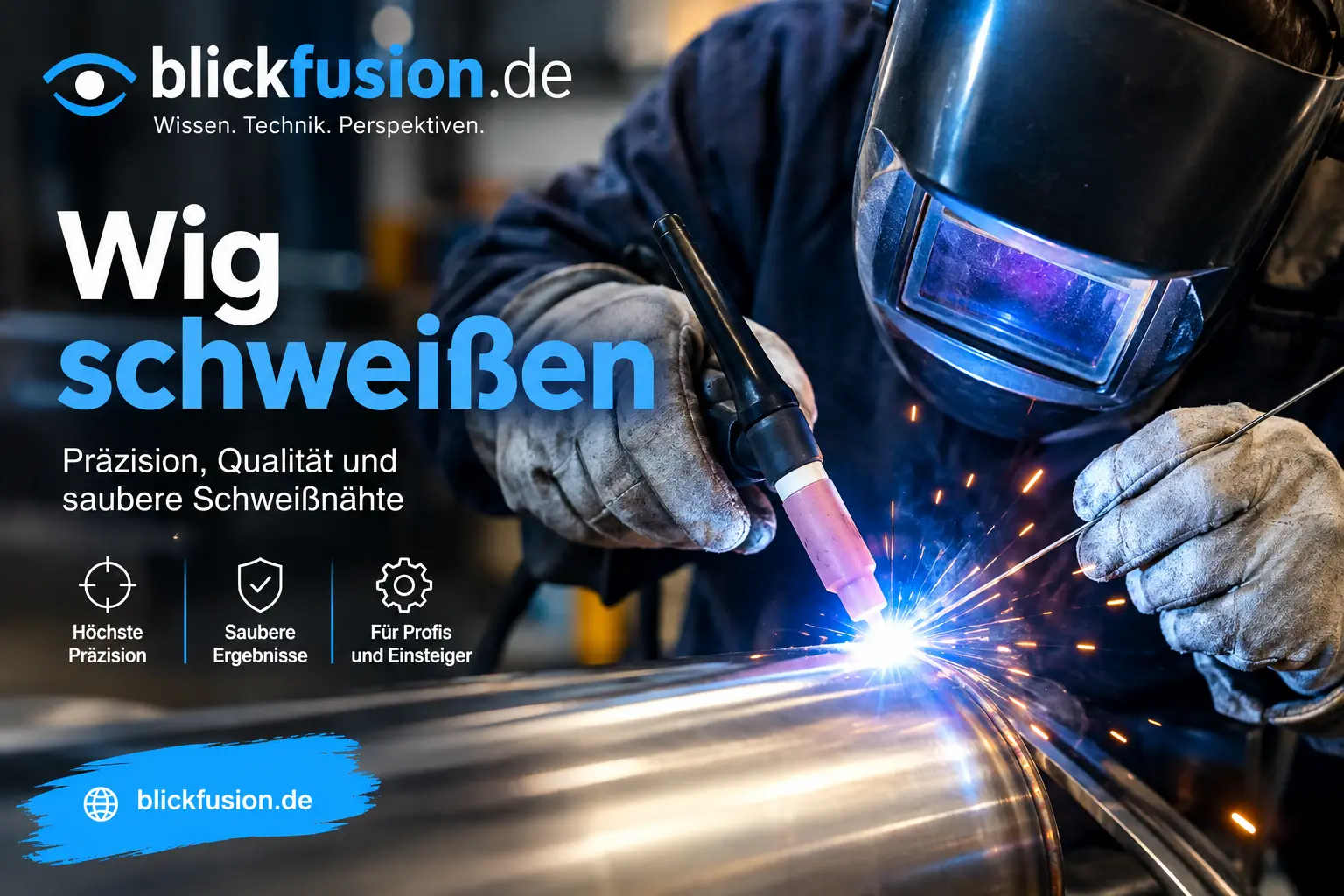
WIG-Schweißen is a precise welding process used when clean, controlled and high-quality joints are important. Unlike processes in which the electrode itself melts into the weld, this method uses a non-consumable tungsten electrode to create the arc. A separate filler rod can be added when required.
For beginners, WIG-Schweißen can initially look complicated because several settings have to work together: current, polarity, tungsten electrode, shielding gas, torch position, travel speed and filler material. Once these elements are understood, however, the process becomes much easier to control.
This guide explains the complete process from the basic principle to material selection, equipment, current settings, preparation, common defects, safety and professional applications. The aim is to give beginners enough practical knowledge to understand what happens during welding and why each setting matters.
Was ist WIG-Schweißen?
WIG stands for Wolfram-Inertgas-Schweißen. The international term TIG welding comes from “Tungsten Inert Gas.” It is an arc welding process in which the electric arc burns between a non-melting tungsten electrode and the workpiece.
The electrode generates the heat needed to melt the base material. A shielding gas, normally argon, flows through the torch nozzle and protects the hot electrode, arc and molten weld pool from the surrounding atmosphere.
Why is this protection necessary? Heated metal reacts easily with oxygen and nitrogen from the air. Such reactions can contaminate the weld and reduce its quality. The inert gas creates a protective atmosphere around the welding zone.
The filler metal is separate from the electrode. It can therefore be introduced manually or, in automated systems, through a wire-feed system. This separation gives the welder considerable control over heat input and weld-metal addition.
Wie funktioniert das Verfahren?
The process begins when the welding machine supplies current to the tungsten electrode. An arc is then established between the electrode and the workpiece.
The arc produces concentrated heat, creating a small molten pool. The welder moves the torch along the joint while maintaining a controlled distance between the tungsten tip and the workpiece.
Shielding gas continuously surrounds the welding area. If filler metal is needed, it is added separately into the leading edge of the molten pool.
The basic sequence is:
- Prepare and clean the joint.
- Select the correct tungsten electrode.
- Choose the appropriate current type.
- Set the shielding gas and flow rate.
- Establish the arc.
- Form a controlled molten pool.
- Add filler metal when required.
- Move the torch consistently along the joint.
- Reduce current gradually at the end when the machine allows it.
- Maintain shielding gas during the required post-flow period.
A key advantage of this arrangement is that the welder controls the heat and filler material separately. That makes it possible to produce very precise welds, particularly on thin sections and demanding components.
Welche Vorteile bietet das Verfahren?
The main reason for choosing this process is control. When the equipment is correctly adjusted and the operator is skilled, the process can produce clean welds with very little spatter.
Important advantages include:
- High control over the arc and heat input
- Clean weld appearance
- Very low spatter
- Precise filler-metal control
- Suitable for thin materials
- Excellent control for root passes
- Suitable for stainless steel and aluminium
- Ability to weld with or without filler material
- Good results on visible or quality-critical joints
- Suitable for manual, mechanized and automated applications
It is particularly useful when weld appearance and accuracy are more important than maximum welding speed. Applications include pipework, vessels, precision fabrication and demanding industrial components.
Welche Nachteile gibt es?
Precision also comes with disadvantages. Compared with faster wire-based processes, this method normally requires more operator coordination and can take longer.
The main disadvantages are:
- Lower productivity than many MIG/MAG applications
- More demanding hand coordination
- Greater sensitivity to contamination
- Requires careful joint preparation
- Shielding gas can be disturbed by drafts
- Tungsten contamination can affect the weld
- Equipment and accessories can be more expensive
- Thick materials may require substantial heat input and multiple passes
Another important point is that the process does not forgive poor preparation easily. Dirt, oil, moisture or an unstable torch position can quickly become visible in the weld.
Welche Materialien eignen sich dafür?
This welding process is suitable for many ferrous and non-ferrous metals when the correct current, electrode, shielding gas and filler material are selected.
Common materials include:
- Stainless steel
- Mild and low-alloy steel
- Aluminium and aluminium alloys
- Copper and copper alloys
- Titanium
- Nickel alloys
- Various corrosion-resistant alloys
Material thickness also matters. Thin sheet can benefit greatly from the precise heat control, while thicker components may require higher current, larger electrodes, filler material and several welding passes.
The material should always be considered together with its alloy, thickness, joint design and required mechanical properties. There is no single setting that works for every grade.
WIG-Schweißen von Edelstahl
Stainless steel is one of the classic applications because the process allows excellent control of heat input and produces clean-looking seams when the joint is properly prepared.
A major concern with stainless steel is excessive heat. Too much heat can create heavy discoloration and may affect the corrosion resistance of the area around the weld.
For clean stainless-steel work:
- Remove grease, oil and dirt before welding.
- Use dedicated stainless-steel cleaning tools.
- Avoid contaminating the joint with ordinary carbon-steel particles.
- Keep the arc short and stable.
- Use adequate shielding gas coverage.
- Control travel speed to avoid unnecessary heat input.
- Allow sufficient post-flow to protect the hot tungsten and weld zone.
A discolored stainless-steel weld is not automatically a failed weld, but heavy oxidation is a warning that shielding or heat control should be investigated.
WIG-Schweißen von Aluminium
Aluminium behaves differently from steel because its oxide layer has a much higher melting temperature than the underlying aluminium. This is one reason aluminium often requires AC operation.
Alternating current helps manage the oxide layer while still providing the heat necessary to form the weld pool.
Before welding aluminium, clean the joint carefully and remove surface contamination. A dedicated stainless-steel brush reserved for aluminium is commonly used for mechanical oxide removal.
Important factors include:
- Correct AC settings
- Suitable tungsten electrode
- Clean base material
- Appropriate shielding gas
- Correct filler alloy
- Controlled travel speed
- Adequate heat management
Aluminium also conducts heat rapidly, so the welding behaviour can change noticeably as the workpiece heats up.
WIG-Schweißen von Stahl, Kupfer und Titan
Steel is commonly welded using direct current with the tungsten electrode connected to the negative side in the conventional DC setup. This provides stable arc characteristics and concentrated heat at the workpiece.
Copper requires special attention because its high thermal conductivity quickly removes heat from the welding zone. Depending on thickness and joint design, preheating and appropriate current selection may be necessary.
Titanium is especially sensitive to contamination. It requires excellent shielding because the hot metal can react strongly with atmospheric gases. Extended gas coverage, suitable torch positioning and careful post-flow are particularly important.
The same machine can therefore be used for several metals, but the setup must change according to the material.
Welche Ausrüstung wird benötigt?
A complete setup normally includes:
- TIG/WIG welding machine
- Welding torch
- Tungsten electrode
- Collet and collet body
- Gas nozzle
- Shielding-gas cylinder
- Gas regulator or flowmeter
- Welding cables and work clamp
- Filler rods where required
- Suitable personal protective equipment
- Cleaning tools
- Optional foot pedal or remote current control
For demanding work, additional features such as high-frequency ignition, pulse control, adjustable AC balance and water cooling can make the process easier or more efficient.
Torch cooling depends on the application. Gas-cooled torches are practical for lower and moderate workloads, while water-cooled systems are used where higher current and longer duty cycles create significant torch heat. Commercial torch systems are available across a wide range of current ratings and electrode sizes.
Die richtige Wolframelektrode auswählen
The tungsten electrode is the component that carries the welding current and establishes the arc. Because it is non-consumable, it should not normally become part of the weld.
Electrodes are available in different compositions and diameters. Common modern choices include lanthanated and other alloyed tungsten types, while pure tungsten has traditionally been associated with certain AC applications.
The electrode diameter should match the current range and welding application. A very small electrode overloaded with current can deteriorate, while an unnecessarily large electrode can make low-current work less responsive.
The tip preparation also depends on the current type and application. DC welding commonly uses a pointed or suitably ground electrode, while AC applications require a setup appropriate to the machine’s waveform and electrode type.
For example, Fronius identifies lanthanated tungsten as a versatile option with good ignition characteristics and stable arc behaviour.
Schutzgas richtig auswählen und einstellen
Shielding gas prevents atmospheric contamination of the arc and molten metal. Argon is the most common choice for general applications because it provides reliable arc starting and stable shielding.
Helium and argon-helium mixtures can also be used for particular applications where increased heat input is beneficial.
Gas flow must not simply be turned up as high as possible. Excessive flow can create turbulence, which may draw surrounding air into the shielding zone instead of improving protection.
A practical starting range for many TIG applications is often around 7–16 l/min with argon, but the correct value depends on nozzle size, torch design, joint configuration, material, gas cup and environmental conditions.
Drafts are another common problem. Even a correctly adjusted flow rate cannot reliably protect the weld if strong airflow carries the shielding gas away.
Welcher Schweißzusatz ist geeignet?
Filler metal should match the base material and the requirements of the finished joint. It is not enough to select a rod simply because its colour or diameter looks appropriate.
The filler choice depends on:
- Base-metal grade
- Required strength
- Corrosion resistance
- Operating temperature
- Joint design
- Welding position
- Post-weld requirements
For aluminium, for example, different alloy families require different filler choices. A 5356-type aluminium filler is one established option for suitable 5xxx and 6xxx alloy applications, but the exact selection must always be checked against the base alloy and application.
The filler diameter should also be appropriate for the size of the weld pool. Feeding a rod that is too large can disturb the pool, while a very thin rod may require excessive feeding.
Welche Stromart ist beim WIG-Schweißen richtig?
The correct current type depends mainly on the material.
DC, or direct current, is widely used for steels, stainless steel, copper and titanium. In conventional DCEN operation, the electrode is negative and the workpiece is positive.
AC, or alternating current, is particularly important for aluminium and is also used for suitable aluminium alloys. The polarity alternates during the welding cycle, supporting oxide management while maintaining the required heat input.
Modern machines may provide extensive waveform and balance controls, allowing the operator to fine-tune arc behaviour.
WIG-Schweißen mit Gleichstrom und Wechselstrom
The difference between DC and AC is not simply a matter of choosing one setting because it “works better.”
With DCEN, the arc is generally stable and well suited to many steels and stainless steels. Heat distribution is favourable for penetrating the workpiece while keeping the tungsten relatively cool compared with electrode-positive operation.
AC continuously changes polarity. This is particularly valuable for aluminium because the positive portion of the cycle supports oxide removal.
Modern equipment can also control AC balance and waveform characteristics. These settings affect cleaning action, penetration, arc stability and electrode loading.
For beginners, the simplest rule is:
- Steel and stainless steel: usually DC
- Aluminium: usually AC
- Copper: commonly DC, depending on the application
- Titanium: commonly DC
- Special alloys: follow the appropriate welding procedure
Wichtige Schweißparameter richtig einstellen
Good weld quality comes from the interaction of several settings rather than one magic number.
The main parameters are:
- Welding current
- Current type
- Electrode diameter
- Electrode geometry
- Shielding-gas type
- Gas flow
- Arc length
- Travel speed
- Filler-rod diameter
- Filler-feed rate
- Torch angle
- AC balance and waveform where applicable
- Pulse frequency and duty cycle where applicable
Pulse welding can help control heat input and is particularly useful in applications where the operator needs better control of the molten pool. Modern machines can provide adjustable pulse current, frequency, base current and duty cycle.
The best approach is to start from a qualified welding procedure or the machine/material manufacturer’s recommendations and then make controlled adjustments.
Welche Stromstärke wird benötigt?
There is no universal amperage because current depends on material type, thickness, joint design, position, electrode size and machine characteristics.
As a general illustration, published equipment data for DC welding of mild steel shows examples ranging from roughly 30–60 A for 0.5 mm material to 200–300 A for around 6 mm, with higher values possible for thicker sections. These are reference ranges, not universal settings.
A useful beginner principle is:
Too little current: the pool forms slowly, penetration may be insufficient and the torch may have to move too slowly.
Too much current: the pool becomes excessively large, edges may melt away and distortion increases.
Always make a test weld on similar material before welding the final component.
WIG-Schweißen ohne Zusatzwerkstoff
Autogenous welding means joining the material without adding a separate filler rod.
This can work well when:
- The joint is tightly fitted.
- The material is thin enough.
- The joint design allows sufficient fusion.
- The required weld size does not demand additional metal.
- The material and application permit it.
Without filler metal, the welder controls the molten edges directly. This can produce very clean results, but poor fit-up or excessive heat can quickly create burn-through.
For thicker materials or joints requiring additional reinforcement, a suitable filler rod is generally more appropriate.
Lesen Sie unseren ausführlichen Ratgeber zum Thema Italienische Mode.
Vorbereitung des Werkstücks
Preparation is one of the most underestimated parts of precision welding.
Before striking the arc:
- Remove oil, grease, paint, dirt and moisture.
- Clean the joint with an appropriate solvent where suitable.
- Mechanically remove oxides where required.
- Ensure the joint edges fit correctly.
- Remove burrs and sharp contamination.
- Position and clamp the components securely.
- Make sure the work clamp has a reliable electrical connection.
- Protect the welding area from drafts.
- Confirm that the shielding gas system is leak-free.
For aluminium and stainless steel especially, cross-contamination from dirty tools can create avoidable welding problems.
A clean joint reduces the number of variables you have to troubleshoot later.
WIG-Schweißen Schritt für Schritt
For a basic manual weld, the workflow can be simplified into the following sequence:
1. Inspect the equipment.
Check the torch, cables, gas connection, electrode and work clamp.
2. Prepare the joint.
Clean the surfaces and establish the correct fit-up.
3. Select the electrode.
Choose its type and diameter according to material and current.
4. Set the machine.
Select AC or DC and establish an appropriate starting current.
5. Set shielding gas.
Use the recommended gas and a suitable flow rate.
6. Position the torch.
Keep the torch stable and maintain a short, controlled arc.
7. Establish the molten pool.
Do not immediately move too quickly. First create a controlled pool.
8. Begin travel.
Move consistently along the joint.
9. Add filler if necessary.
Introduce the rod into the leading edge of the molten pool rather than repeatedly dipping it into the tungsten.
10. Finish correctly.
Reduce heat in a controlled way where the machine provides downslope control, and allow post-flow to protect the hot electrode and weld area.
11. Inspect the weld.
Look for cracks, pores, excessive oxidation, undercut, lack of fusion and inconsistent bead shape.
Die richtige Brennerführung
Torch movement has a direct effect on the weld.
The torch should remain stable, and the arc should generally be kept short. Excessive arc length widens the heat-affected area and makes shielding less effective.
The torch angle should allow the shielding gas to cover the molten pool without pushing the gas away from the joint.
When filler is used, the rod should be introduced smoothly into the front portion of the pool. Avoid touching the tungsten with the filler rod. If tungsten contamination occurs, stop, allow the electrode to cool as appropriate, then regrind or replace it according to the situation.
A steady hand is usually more valuable than trying to move quickly.
Typische Fehler beim WIG-Schweißen vermeiden
Beginners often focus on the machine settings and overlook technique.
Common mistakes include:
- Holding the arc too long
- Moving the torch too quickly
- Moving too slowly and overheating the material
- Using excessive gas flow
- Allowing drafts around the workpiece
- Welding over contaminated surfaces
- Touching the tungsten with filler metal
- Using the wrong current type
- Choosing an unsuitable electrode
- Feeding filler inconsistently
- Forgetting post-flow
- Poor joint fit-up
When a weld looks wrong, change one variable at a time. If current, gas flow, travel speed and electrode geometry are all changed simultaneously, it becomes difficult to identify the actual cause.
Poren, Verfärbungen und schlechte Schweißnähte
Porosity appears as small cavities or holes in the weld and can result from inadequate shielding, contamination, moisture, leaks, excessive gas turbulence or drafts.
Heavy discoloration on stainless steel can indicate excessive heat or insufficient shielding. The exact significance depends on material, application and welding procedure.
Undercut occurs when the edge of the base material is melted away without being properly filled.
Lack of fusion means the weld metal has not properly fused with the joint surfaces.
Burn-through occurs when excessive heat creates a hole through thin material.
A useful troubleshooting order is:
- Check cleanliness.
- Check gas supply and leaks.
- Check gas flow and drafts.
- Check electrode condition.
- Check arc length.
- Check current.
- Check travel speed.
- Check filler technique.
- Reassess joint preparation.
WIG-Schweißen für Anfänger
The best way to learn is to start with simple joints rather than immediately attempting complex pipework or thin aluminium.
A beginner should first understand:
- What the arc does
- How the molten pool behaves
- How arc length affects the weld
- How torch movement changes heat input
- How filler rod affects the pool
- Why shielding gas is necessary
- How AC differs from DC
- How tungsten contamination happens
- How to recognize basic weld defects
Practice on clean, inexpensive material and make short test welds. Concentrate on one skill at a time.
First learn to create a stable pool. Then practice travel speed. After that, add filler consistently. This approach is much easier than trying to master every movement simultaneously.
Wichtige Sicherheitsmaßnahmen
Arc welding produces intense ultraviolet and infrared radiation, heat, fumes and electrical hazards. Cylinders and shielding gases also require proper handling.
Basic protection includes:
- Correct welding helmet with suitable shade
- Welding gloves
- Flame-resistant clothing
- Appropriate safety footwear
- Eye protection for preparation and grinding
- Adequate ventilation or suitable fume extraction
- Safe handling of gas cylinders
- Proper electrical connections
- Removal of combustible materials from the work area
- Awareness of hot metal after welding
Never weld in an enclosed or poorly ventilated area simply because the process appears clean. The absence of visible smoke does not automatically mean the air is safe.
Follow the welding machine manual, workplace safety rules and applicable local regulations.
WIG-Schweißen im professionellen Einsatz
Professional welding places greater emphasis on repeatability, documented procedures and inspection.
Industrial applications may use:
- Manual welding
- Mechanized welding
- Orbital welding
- Automated welding
- Robotic welding
- Pulse-controlled welding
- Precision pipe welding
- Multi-pass welding
The process is used in sectors such as pipe construction, vessel manufacturing, precision fabrication and aerospace-related applications.
Professional work may also require qualified welding procedures, traceable materials, inspection records and operator qualifications depending on the industry and applicable standards.
Anwendungsbereiche und Einsatzgebiete
Typical applications include:
- Stainless-steel fabrication
- Aluminium components
- Pipe and tube welding
- Pressure-related fabrication
- Food and pharmaceutical equipment
- Automotive components
- Chemical equipment
- Precision engineering
- Repair work
- Aerospace-related manufacturing
- Decorative and visible welds
The process is especially useful when the appearance, cleanliness and precision of the joint matter.
It is not automatically the fastest choice. For high-volume production where speed is the main requirement, another welding process may be more appropriate.
WIG-Schweißen vs. MIG/MAG: Die wichtigsten Unterschiede
Both processes use shielding gas and an electric arc, but their electrode systems are different.
| Feature | TIG/WIG | MIG/MAG |
|---|---|---|
| Electrode | Non-consumable tungsten | Consumable wire |
| Filler | Separate rod or wire | Welding wire continuously supplied |
| Control | Very high | High |
| Spatter | Usually very low | Can be higher |
| Speed | Generally slower | Generally faster |
| Thin precision work | Excellent | Good depending on application |
| Operator coordination | Higher | Generally easier to learn |
| Automation | Possible | Possible |
MIG/MAG is widely used where productivity and deposition rate are important, while TIG/WIG is selected when precise control and clean welds are priorities.
WIG-Schweißen vs. andere Schweißverfahren
There is no single welding method that is ideal for every application.
MMA/stick welding is highly portable and useful for many repair and construction applications, but electrode changes and slag handling make it different from TIG.
Plasma welding can provide a highly concentrated arc and is used in specialized applications.
Laser welding can offer very high precision and speed in suitable industrial environments, but it requires different equipment, process control and investment.
The correct process depends on material, thickness, joint geometry, production volume, required appearance, tolerances and budget.
Welche Schweißnahtqualität ist möglich?
When the joint is properly prepared and the parameters are controlled, TIG can produce very clean, narrow and visually consistent welds.
Quality depends on much more than the welding machine. Important factors include:
- Material cleanliness
- Correct filler selection
- Electrode condition
- Shielding gas protection
- Current stability
- Arc length
- Travel speed
- Joint preparation
- Operator technique
- Heat input
A visually attractive weld is not automatically a structurally acceptable weld. For safety-critical components, weld quality must be assessed according to the relevant specification and inspection requirements.
Was kostet WIG-Schweißen?
The cost depends on whether you weld yourself or use a professional service.
For DIY work, the initial investment may include:
- Welding machine
- Torch
- Tungsten electrodes
- Gas equipment
- Argon
- Filler rods
- Consumables
- Protective equipment
- Cleaning and grinding tools
Professional service pricing depends on material, thickness, joint complexity, welding position, preparation time, filler material, inspection requirements and the number of welds.
A small repair can therefore have a completely different price from a precision stainless-steel fabrication job or a qualified industrial welding project.
When comparing quotations, look beyond the hourly rate. Preparation, consumables, shielding gas, inspection and finishing may all affect the final cost.
Häufig gestellte Fragen
What does WIG mean?
WIG stands for Wolfram-Inertgas-Schweißen. The international English term is TIG, meaning Tungsten Inert Gas welding.
Which gas is normally used?
Pure argon is the common starting choice for many applications. Helium or argon-helium mixtures can be useful for specific applications.
Can beginners learn the process?
Yes. The technique requires practice, but beginners can learn it systematically by starting with clean, simple joints and gradually adding more variables.
Can aluminium be welded with TIG?
Yes. Aluminium is commonly welded using AC because the alternating current helps manage its oxide layer.
Can stainless steel be welded with TIG?
Yes. Stainless steel is a major application because the process offers excellent control and clean welds when shielding and heat input are properly managed.
Does the tungsten electrode melt?
Normally, no. The tungsten electrode is designed to remain non-consumable. If it repeatedly melts or becomes contaminated, the electrode type, current, polarity, arc length or technique should be checked.
Is filler metal always necessary?
No. Some closely fitted joints and thin materials can be welded autogenously. Other joints require filler to achieve the required weld size or properties.
Why does a stainless-steel weld turn dark?
Dark or heavy discoloration can indicate excessive heat or inadequate shielding. The cause should be investigated rather than simply polishing the surface afterward.
How much argon is needed?
There is no universal flow rate. Torch and nozzle design, material and working conditions all matter. Many applications fall within a broad range around 7–16 l/min, but the equipment and welding procedure should determine the final setting.
What causes pores in a weld?
Common causes include poor shielding, contamination, gas leaks, excessive gas turbulence, drafts and moisture.
What is the difference between AC and DC?
DC keeps current direction essentially constant and is widely used for steels and stainless steel. AC alternates polarity and is especially useful for aluminium.
Can copper be welded using TIG?
Yes, but copper’s high thermal conductivity can require careful heat management and, depending on the application, preheating.
Is TIG suitable for thick metal?
It can be, but thick sections may require high current, larger electrodes, suitable cooling and multiple passes. Another welding process may be more productive for large-volume thick-material work.
What is HF ignition?
High-frequency ignition starts the arc without requiring the tungsten to touch the workpiece. This can reduce tungsten contamination and make arc starting more controlled.
Fazit
TIG welding is a precision-oriented process built around a non-consumable tungsten electrode, controlled arc, shielding gas and optional filler metal. Its strength is not simply producing an attractive weld; it gives the operator unusually precise control over heat and filler addition.
For beginners, the most important foundations are clean preparation, the correct electrode, suitable shielding gas, the right current type, stable torch movement and controlled heat input. Stainless steel is commonly handled with DC, while aluminium generally requires AC.
Once these fundamentals are understood, more advanced techniques such as pulse control, AC waveform adjustment, mechanized welding and specialized joint procedures become much easier to understand.
The key is to treat every weld as a combination of material, thickness, joint design, electrode, gas, current and technique. When those elements are matched correctly, the process can deliver precise, clean and highly controlled results across a wide range of professional and practical applications.
Lesen Sie unseren ausführlichen Ratgeber zum Thema Einschreiben verfolgen.