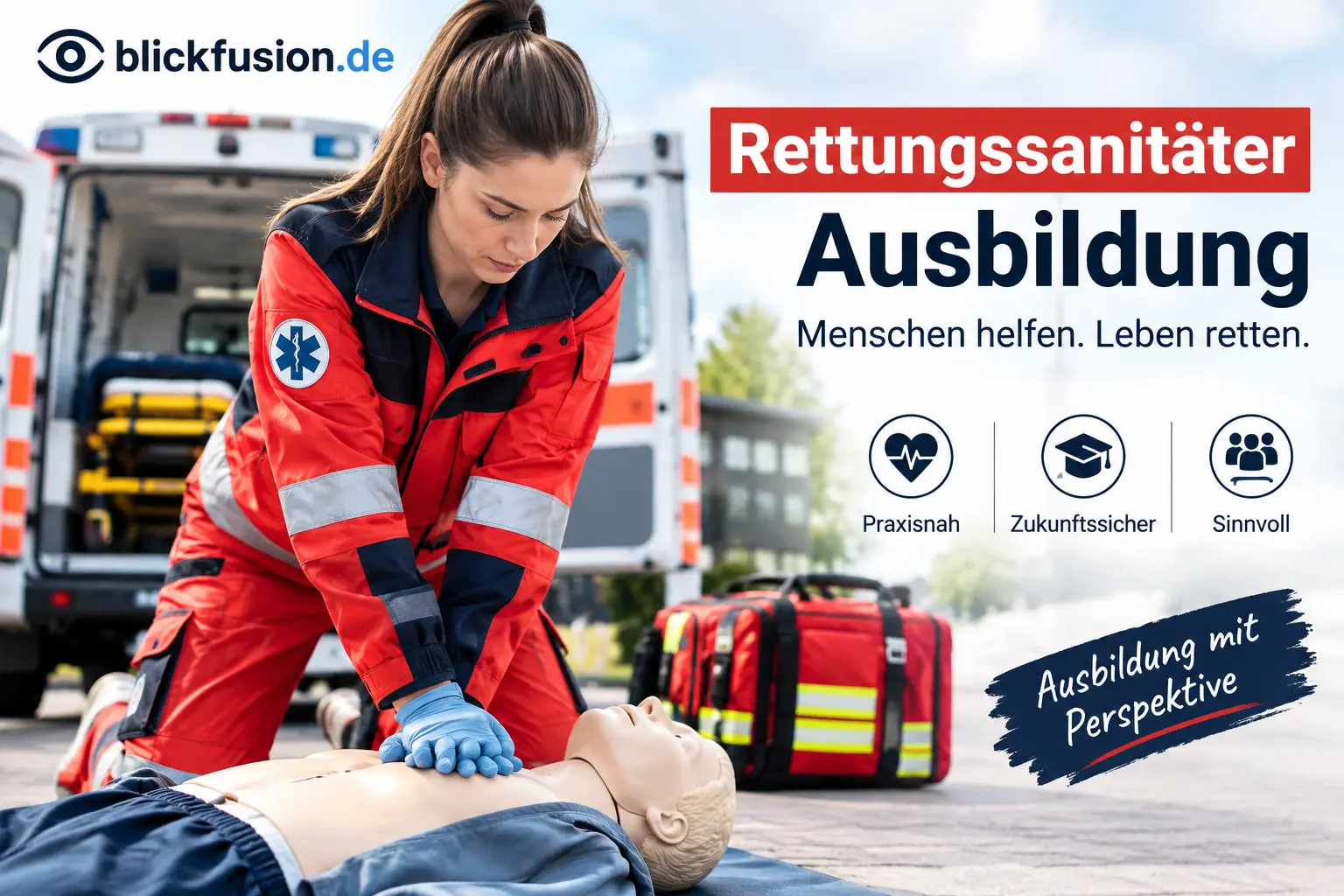
Choosing a career in emergency medical services can feel overwhelming at first. There are unfamiliar terms, practical placements, examinations, legal requirements and questions about costs and future employment. The Rettungssanitäter Ausbildung is one of the common entry routes into the German rescue service, but the exact rules and organisation can differ depending on the federal state and training provider.
The Rettungssanitäter Ausbildung generally combines classroom-based learning with practical experience in a hospital and at a teaching ambulance station. In many current programmes, the overall qualification is based on a 520-hour training model, although the precise structure and legal details depend on the applicable state rules. Current 2026 programmes listed by the Federal Employment Agency also show differences in duration, cost, location and funding options.
This guide explains the complete pathway in simple terms: who can enter the profession, what is learned, how the practical phases work, what the qualification costs, how funding may work, what happens during the examination and what career options are available afterward.
Rettungssanitäter Ausbildung 2026: Voraussetzungen und wichtige Informationen
A Rettungssanitäter is a trained member of the emergency medical services who can work in qualified patient transport, emergency response and other areas of rescue and civil protection. The qualification is different from the three-year professional training for a Notfallsanitäter.
One important point for beginners is that Germany does not operate every detail of Rettungssanitäter training through one identical nationwide training schedule. Federal-state regulations and recognised training providers can determine specific requirements. For example, Bavaria requires at least 520 hours and specifies its own structure, while North Rhine-Westphalia also regulates a minimum of 520 training hours through its RettAPrVO NRW.
Quick overview
- Qualification: Rettungssanitäter/in
- Typical training model: 520 hours
- Main components: theory, hospital placement, ambulance-station placement, final course and examination
- Training location: recognised training institution plus practical facilities
- Possible workplaces: patient transport, emergency services, civil protection and related rescue-service operations
- Funding: some current programmes are eligible for a Bildungsgutschein, subject to individual approval
- Duration: often several months in full-time programmes, but the schedule depends on the provider and training model
- Costs: vary considerably between providers and locations
- Further career path: employment in rescue services or progression toward further qualifications such as Notfallsanitäter
The most important practical advice is to check the rules that apply where you intend to train rather than assuming that an offer in one federal state automatically has exactly the same conditions as another.
Was macht ein Rettungssanitäter?
A Rettungssanitäter supports the care and transport of ill or injured people. The job can involve routine patient transport as well as supporting emergency crews when urgent medical assistance is required.
Typical responsibilities include:
- assessing the patient’s condition within the scope of the qualification
- measuring and monitoring vital signs
- preparing patients for transport
- safely transferring and positioning patients
- assisting with emergency medical measures
- preparing and checking rescue equipment
- maintaining hygiene and operational readiness
- communicating with patients, relatives and other emergency personnel
- documenting relevant information
- supporting a Notfallsanitäter or physician during emergency operations when required
What happens during a typical shift?
A working day can be very different from one shift to another. A team may spend part of the day handling qualified patient transport and then suddenly receive an emergency call.
This requires more than medical knowledge. Communication, teamwork, calm decision-making, physical resilience and reliable adherence to procedures are important parts of the job.
A current NRW training provider describes possible roles in qualified patient transport, emergency response and civil protection. It also explains that Rettungssanitäter can work as transport personnel in patient transport and, depending on the operational structure, as a driver on a rescue vehicle while supporting the Notfallsanitäter in emergency care.
Voraussetzungen für die Ausbildung
The admission requirements should always be checked with the training provider and the responsible state authority because individual requirements can vary.
Common requirements include:
- appropriate health for the occupation
- sufficient German language ability
- reliable personal conduct
- the required school qualification or an equivalent qualification
- completion of a first-aid course where required
- successful participation in the required training sections
- any documents requested by the training institution
Bavaria, for example, requires health suitability, at least a Mittelschule qualification or equivalent education or completed vocational training, and participation in first-aid training. The Bavarian regulation also sets requirements concerning age, reliability and German-language knowledge for practising as a Rettungssanitäter.
Welchen Schulabschluss braucht man?
There is no simple answer that applies identically to every training route in Germany.
A Mittelschule-level qualification or an equivalent school education is specifically included in Bavaria’s access requirements. Other providers may formulate their admission requirements differently, so applicants should check the exact programme rather than assuming that Abitur is mandatory.
Is Abitur required?
Usually, the decisive question is whether you meet the admission conditions of the particular training route. The career is therefore not automatically restricted to people with Abitur.
Some providers also explicitly target career changers and entrants without previous rescue-service employment.
What about health requirements?
Health suitability matters because the work can involve lifting, moving patients, working under time pressure and dealing with physically demanding situations.
Depending on the provider, you may be asked for a medical certificate or other evidence of fitness.
Do I need a first-aid course?
A first-aid qualification is an important part of preparation. In Bavaria, participation in first-aid training is explicitly listed among the access requirements.
Because admission rules can differ, check whether the provider specifies a particular certificate, maximum age of the certificate or additional requirements.
Wie läuft die Ausbildung ab?
The training is designed to move you from basic theory toward supervised practical work and finally toward the examination.
The general progression looks like this:
- theoretical and practical instruction
- clinical placement
- placement at a teaching ambulance station
- final training phase
- examination and qualification
The order and exact structure can depend on the applicable regulation.
In NRW, for example, the regulation specifies a 240-unit theoretical-practical section, an 80-hour clinical-practical section, at least 160 hours of practical training at an authorised teaching ambulance station and a final section.
Bavaria uses a different distribution within the same overall 520-hour framework, with at least 160 teaching units of theory, 160 clinical placement hours, 160 ambulance-station placement hours and 40 teaching units for the final course.
That difference is important: 520 hours does not necessarily mean every state divides those hours into exactly the same blocks.
Rettungssanitäter Ausbildung: Die 520 Stunden im Überblick
The 520-hour model is one of the most important concepts for anyone researching the qualification.
However, applicants should distinguish between hours of classroom instruction and practical hours. A Unterrichtseinheit is often 45 minutes, whereas a practical Ausbildungsstunde may be defined as 60 minutes under the applicable regulation.
Common 520-hour model
| Training section | Typical scope |
|---|---|
| Theoretical-practical basic course | 240 units in the NRW model |
| Clinical placement | 80 hours in the NRW model |
| Ambulance-station placement | 160 hours |
| Final course | 40 units |
| Examination | Required final qualification step |
NRW explicitly describes the 240 + 80 + 160 + 40 structure, while Bavaria’s current regulation distributes the 520 hours as 160 teaching units, 160 clinical hours, 160 ambulance-station hours and 40 teaching units.
So if you see a provider advertising a “520-hour programme”, do not assume that every hour has the same format.
Inhalte der Ausbildung
The curriculum is designed to provide both medical foundations and practical rescue-service skills.
Typical subjects include:
- anatomy and physiology
- pathology and disease patterns
- first aid
- resuscitation
- emergency medicine
- patient assessment
- vital signs
- hygiene and infection prevention
- communication
- psychology and dealing with patients
- legal foundations
- professional responsibilities
- documentation
- rescue-service organisation
- operational tactics
- medical equipment
- patient transport
- trauma care
- assistance during emergency medical measures
Current 2026 listings from the Federal Employment Agency include areas such as professional and legal foundations, anatomy and physiology, disease theory, hygiene, first aid, assessment of sick and injured people, emergency medicine, operational tactics and practical placements.
Why are anatomy and physiology important?
You need to understand how the healthy human body functions before you can recognise what may be abnormal.
For example, understanding normal breathing, circulation and consciousness helps you recognise changes that may indicate a medical emergency.
Why is communication part of emergency training?
Patients may be frightened, confused, in pain or unable to communicate normally. A rescue professional must therefore collect information, explain what is happening and work with the patient and the rest of the team.
Good communication can also make practical procedures safer and more efficient.
Grundlehrgang und theoretische Ausbildung
The basic course provides the foundation for later practical placements.
Students normally learn how to:
- assess patients systematically
- recognise common emergency situations
- measure vital signs
- use rescue equipment
- understand basic anatomy and physiology
- apply hygiene principles
- communicate professionally
- understand legal responsibilities
- assist with emergency treatment
- prepare patients for transport
In NRW, the initial theoretical-practical course comprises 240 Unterrichtseinheiten and must be successfully completed before the subsequent training sections can be undertaken.
This stage is not simply “sitting in a classroom”. Practical exercises and simulations are important because rescue work requires the ability to apply knowledge under realistic conditions.
Klinikpraktikum
The hospital placement connects classroom knowledge with real patient care.
During a Klinikpraktikum, trainees can observe and participate in appropriate activities under supervision. The exact departments and duties depend on the training provider and applicable rules.
You may encounter areas such as:
- emergency department
- intensive care-related environments
- patient admission
- general clinical care
- surgical or medical departments
The purpose is not to turn a trainee into a hospital nurse or physician. Instead, the placement helps you understand patient conditions, clinical workflows, hygiene, observation and communication.
One major advantage of this stage is learning how information from the pre-hospital setting connects with the receiving hospital.
Rettungswachenpraktikum
The Rettungswachenpraktikum is where the training becomes strongly connected to daily rescue-service operations.
You learn how a rescue station functions before, during and after an emergency call.
Typical learning areas include:
- preparing vehicles
- checking medical equipment
- maintaining operational readiness
- preparing for patient transport
- working within a rescue-service team
- assisting during deployments
- documenting information
- learning operational routines
- communicating with dispatch and other personnel
The actual responsibilities remain subject to supervision and the rules governing the qualification.
In the NRW framework, at least 160 practical training hours are completed at an authorised Lehrrettungswache.
Abschlusslehrgang und Prüfung
The final training phase brings the theory and practical experience together.
In NRW, the Abschlusslehrgang comprises 40 Unterrichtseinheiten of 45 minutes and is followed by the state examination.
The final stage is designed to identify knowledge gaps, reinforce practical competence and prepare candidates for assessment.
What should you do before the final examination?
Do not wait until the final week to revise everything.
A better approach is to review throughout the programme:
- patient assessment
- vital signs
- emergency algorithms taught during your course
- anatomy and physiology
- common disease patterns
- trauma
- resuscitation
- hygiene
- documentation
- legal responsibilities
- equipment handling
The exact examination format depends on the applicable regulation and training route, so the examination requirements supplied by your recognised training institution should be treated as the final preparation reference.
Dauer der Ausbildung
A full-time programme can often be completed within several months, but there is no single duration that applies to every provider.
Current 2026 listings from the Federal Employment Agency include programmes classified as lasting one to three months, three to six months, and other schedules depending on the course structure.
The reason for these differences is simple: the 520 hours must be fitted around classroom instruction, practical placements, examination dates and the provider’s scheduling system.
Bavaria’s regulation also allows the training to be completed over a longer period, with the qualification normally completed within three years from the start and possible extension in defined circumstances.
What determines the actual duration?
- full-time or part-time attendance
- availability of practical placements
- course dates
- examination dates
- provider scheduling
- recognised previous qualifications
- interruptions
- individual circumstances
A programme advertised as “three months” should therefore be understood as the schedule of that particular provider, not as a universal German rule.
Kosten der Ausbildung 2026
Training costs vary significantly.
Current 2026 entries in the Federal Employment Agency’s training database show examples such as:
- around €2,280 in Minden
- around €3,380 in Essen
- around €3,736 in Berlin
- around €4,040 for another Berlin programme
- around €2,650 for a Hamburg programme
These are individual course offers rather than a nationwide official price range.
A separate ASB NRW programme lists a 2026 basic-course price of €1,500 including certain course-related services and the first examination fee.
Why do prices differ?
The total price may depend on:
- number of classroom hours
- practical organisation
- examination fees
- teaching materials
- certification
- provider
- location
- whether additional services are included
- whether you already hold a related qualification
- whether the programme is funded
Before registering, ask the provider for a complete cost breakdown.
Rettungssanitäter Ausbildung mit Bildungsgutschein
A Bildungsgutschein can make a major difference for people who cannot or do not want to pay the training cost themselves.
The Federal Employment Agency currently lists multiple rescue-service training programmes with possible funding through a Bildungsgutschein. However, funding is not automatic simply because a course appears in the database. The individual requirements are assessed by the Agentur für Arbeit or Jobcenter.
Who can receive funding?
Eligibility depends on your personal situation and the funding authority’s assessment.
Possible situations can include:
- unemployment
- risk of unemployment
- professional reorientation
- need for occupational qualification
- other circumstances recognised under the applicable funding rules
What should you check?
Before enrolling, verify:
- whether the exact course is eligible for funding
- whether the provider has the required approval
- whether your personal situation meets the funding requirements
- which costs are covered
- whether travel or other associated expenses may be covered
- whether you need approval before signing a training contract
The safest approach is to speak with the responsible Agentur für Arbeit or Jobcenter before committing to the course.
Finanzierung und mögliche Förderungen
A Bildungsgutschein is not the only point applicants should consider.
Depending on the individual situation, potential funding or cost-support routes can involve:
- Agentur für Arbeit
- Jobcenter
- Deutsche Rentenversicherung in appropriate cases
- employer-supported qualification
- other individual funding arrangements
Current Federal Employment Agency listings show programmes where Bildungsgutschein and, in some cases, other funding routes are indicated.
The important distinction is between a course being fundable and you personally being entitled to funding. Those are not the same thing.
Ausbildung in Vollzeit oder Teilzeit
Full-time training is usually easier to organise when you want to complete the qualification within a relatively short period.
Part-time training can be useful for people who:
- already have a job
- have family responsibilities
- need more flexibility
- cannot attend full-time classes
- need to coordinate practical placements around another commitment
Current 2026 listings demonstrate that both full-time and part-time formats exist. For example, the Federal Employment Agency lists a Hamburg programme as part-time, while other current offers are full-time.
Which format should you check first?
Look at the complete timetable rather than only the advertised duration.
A shorter-looking programme may require intensive attendance, while a part-time route may take longer but fit your circumstances better.
Lesen Sie unseren ausführlichen Ratgeber zum Thema WIG-Schweißen.
Rettungssanitäter Ausbildung für Quereinsteiger
The qualification can be relevant for people changing careers or entering the rescue service without a previous professional background in emergency medicine.
A career changer should nevertheless understand that the job is not simply “driving an ambulance”. It involves patient contact, medical responsibilities within the scope of the qualification, documentation, teamwork, physical demands and emotionally difficult situations.
What should career changers consider?
Before enrolling, consider:
- Can you work shifts?
- Are you comfortable with blood and injuries?
- Can you communicate calmly with distressed people?
- Can you work in a team?
- Are you physically able to move and transport patients?
- Can you follow procedures precisely?
- Can you handle changing working hours?
- Are you prepared for practical placements?
- Do you want to continue toward a higher qualification later?
A realistic understanding of the work is more useful than choosing the course solely because it can be completed comparatively quickly.
Rettungssanitäter werden ohne Abitur
Abitur is not automatically the central requirement for this qualification.
For example, Bavaria’s regulation specifies at least a Mittelschule qualification or equivalent education, or a completed vocational qualification, alongside other admission requirements.
Other training providers can have additional or differently worded entry conditions.
Therefore, if you do not have Abitur, check the exact admission requirements of the programme you want to attend rather than assuming that you are excluded.
Wo kann man die Ausbildung machen?
Training is offered through recognised educational institutions and rescue-service training organisations.
Depending on the region, applicants may encounter programmes connected with:
- Arbeiter-Samariter-Bund
- Deutsches Rotes Kreuz
- Johanniter-Unfall-Hilfe
- Malteser Hilfsdienst
- municipal rescue services
- private recognised rescue-service schools
- other approved educational providers
The important factor is not simply the brand name. Check whether the specific institution and programme meet the recognition requirements applicable to your training route.
What should you compare before choosing a provider?
Compare:
- recognition status
- complete price
- examination fees
- practical-placement arrangements
- course dates
- full-time or part-time format
- funding eligibility
- location
- class size
- examination arrangements
- support during practical placements
Rettungssanitäter Ausbildung nach Bundesland
Germany’s federal structure matters for this qualification.
The broad 520-hour framework appears in multiple current training routes, but the detailed legal implementation can differ between states.
For example, Bavaria currently regulates at least 520 hours with 160 teaching units of theory, 160 clinical hours, 160 ambulance-station hours and 40 final-course units. NRW specifies a different distribution with 240 theoretical-practical units, 80 clinical hours, 160 ambulance-station hours and a 40-unit final course.
This is why applicants should always verify local requirements.
Rettungssanitäter Ausbildung in Bayern
Bavaria has a specific Bayerische Rettungssanitäterverordnung.
The regulation requires:
- at least 18 years of age for practising as a Rettungssanitäter
- appropriate qualification
- reliability
- health suitability
- required German-language knowledge
For admission to training, Bavaria specifies health suitability, at least a Mittelschule qualification or equivalent education or completed vocational training, and participation in first-aid training.
The Bavarian training structure consists of at least:
- 160 Unterrichtseinheiten theoretical training
- 160 clinical placement hours
- 160 ambulance-station placement hours
- 40 Unterrichtseinheiten final course
The total is at least 520 hours, followed by the final examination.
Rettungssanitäter Ausbildung in Nordrhein-Westfalen
North Rhine-Westphalia has the RettAPrVO NRW, which regulates the training and examination of Rettungssanitäter and Rettungshelfer.
The regulation specifies at least 520 training hours and the following major components:
- 240 Unterrichtseinheiten theoretical-practical training
- 80 clinical-practical hours
- at least 160 practical hours at an approved Lehrrettungswache
- final training and examination components
Current 2026 NRW course schedules show that programmes are actively offered throughout the year. For example, the ASB Landesschule NRW lists several 2026 basic courses and states a price of €1,500 for its listed basic programme.
Rettungssanitäter Ausbildung in Berlin
Berlin has several routes into rescue-service careers, including programmes listed through the Federal Employment Agency and opportunities connected with the Berliner Feuerwehr.
Current 2026 Federal Employment Agency listings include Berlin courses with several-month schedules, practical placements, and Bildungsgutschein eligibility. One listed programme includes 160 hours at a teaching ambulance station and 160 hours of clinical placement and requires, among other things, an age of at least 18, health suitability, German-language ability and resilience.
Berlin’s official career information also describes routes through the Berliner Feuerwehr where a 520-hour Rettungssanitäter qualification is integrated into certain firefighter entry pathways.
This means applicants in Berlin should distinguish between an independent qualification course and a firefighter career route that includes rescue-service training.
Rettungssanitäter Ausbildung in Hamburg
Hamburg also has current training offers listed through the Federal Employment Agency.
A 2026 listing in Hamburg shows a programme with a full-time format and a listed cost of €2,650, while other Hamburg rescue-service educational pathways may have different structures and dates.
Applicants should therefore compare individual providers instead of assuming that every Hamburg programme has the same schedule or price.
Rettungssanitäter Ausbildung in Baden-Württemberg
Baden-Württemberg has its own state-specific structures for rescue-service education.
Current training listings also demonstrate that different routes can exist depending on previous qualifications. For example, a current Federal Employment Agency listing in Mannheim describes an advanced route for people who already have a Rettungshelfer qualification and specified practical experience.
This is a useful reminder that not every applicant starts from zero. Previous rescue-service training can sometimes change the route and remaining requirements.
Rettungssanitäter Ausbildung in Hessen
In Hessen, applicants should check the requirements of the recognised training institution and the applicable state framework before registration.
Important points to verify include:
- admission requirements
- total training hours
- practical placement requirements
- examination procedure
- recognition of previous training
- course dates
- total cost
- funding eligibility
The same principle applies throughout Germany: a course advertised online is not necessarily identical to a course offered in another federal state.
Rettungssanitäter Ausbildung in Niedersachsen
In Lower Saxony, applicants should likewise compare recognised providers and confirm the current local requirements.
When comparing courses, pay particular attention to whether the advertised price includes the practical components and examination or whether additional fees arise later.
This is especially important when comparing a short course advertisement with a complete qualification programme.
Ausbildung in der Nähe finden
Local search can make a major difference because the practical placements cannot simply be completed anywhere without regard to the programme’s requirements.
When searching locally, use combinations such as:
- Rettungssanitäter Schule + city
- Rettungsdienstschule + postcode
- Rettungssanitäter Kurs + city
- Lehrrettungswache + region
- Rettungssanitäter Weiterbildung + city
Then verify the provider’s recognition, next start date, costs and practical-placement arrangements.
What should a local comparison include?
Create a simple checklist:
| Factor | What to check |
|---|---|
| Location | Classroom and practical sites |
| Start date | Next available course |
| Duration | Full-time or part-time |
| Cost | Complete price including examination |
| Funding | Bildungsgutschein or other support |
| Recognition | Appropriate approval |
| Practical training | Hospital and ambulance station |
| Examination | Included or separate |
| Entry requirements | Age, education, health and documents |
This approach is more useful than choosing a course only because it appears first in a local search result.
Prüfung und Abschluss
The examination is the final step that confirms successful completion of the qualification.
The exact assessment depends on the applicable state regulation.
Preparation normally involves both knowledge and practical competence. You should be comfortable with:
- patient assessment
- vital signs
- emergency procedures taught during training
- anatomy and physiology
- common medical conditions
- trauma
- resuscitation
- hygiene
- equipment
- communication
- documentation
- legal and professional responsibilities
In NRW, the initial course includes a successful section examination before later practical stages, followed by the final training phase and state examination.
If a candidate does not pass, the applicable regulation determines the possibilities for repeating the assessment.
Bavaria, for example, specifically provides for participation in the next possible repeat examination in defined circumstances.
Aufgaben und Einsatzbereiche
The qualification can lead to several operational functions.
Depending on the employer and local structure, tasks can include:
- qualified patient transport
- emergency response support
- patient observation
- transport preparation
- assistance to higher-qualified rescue personnel
- vehicle preparation
- equipment checks
- documentation
- hygiene
- civil protection activities
The scope of responsibility is important. A Rettungssanitäter does not have the same professional qualification or legal scope as a Notfallsanitäter.
Wo arbeiten Rettungssanitäter?
Possible employers and areas include:
- public or municipal rescue services
- charitable rescue organisations
- private rescue-service providers
- patient transport services
- disaster protection organisations
- civil protection
- event medical services
- emergency-service training organisations
The exact job profile depends on the employer and the position.
Some roles focus heavily on Krankentransport, while others involve regular participation in emergency-service operations.
Gehalt nach der Ausbildung
There is no single nationwide salary figure that accurately represents every Rettungssanitäter.
Pay can depend on:
- employer
- collective agreement
- region
- professional experience
- working hours
- shift system
- night work
- weekend work
- public holidays
- additional responsibilities
This is why salary comparisons should distinguish between basic gross pay and additional allowances.
What does gross salary mean?
Gross salary is the amount before deductions such as taxes and social insurance contributions.
Net salary is the amount that reaches your account after deductions.
Two people with the same gross salary can therefore receive different net amounts because of factors such as tax class and personal circumstances.
For a realistic salary comparison, look at the employer’s current job advertisement or applicable collective agreement rather than relying on an old salary blog post.
Karriere- und Weiterbildungsmöglichkeiten
The qualification can be a starting point rather than the end of a rescue-service career.
Possible development paths can include:
- additional rescue-service qualifications
- specialised training
- practical teaching roles after meeting relevant requirements
- organisational responsibilities
- further education in emergency medical services
- progression toward Notfallsanitäter
Career development depends on the employer, previous education, experience and the requirements of the next qualification.
Rettungssanitäter oder Notfallsanitäter?
These two qualifications should not be treated as interchangeable.
Main differences
| Area | Rettungssanitäter | Notfallsanitäter |
|---|---|---|
| Training route | Qualification course | Three-year vocational training |
| Training scope | Commonly based on 520-hour framework | Much more extensive professional training |
| Role | Support and qualified patient transport/emergency-service functions | Higher-qualified professional emergency care |
| Training duration | Often several months depending on model | Three years |
| Career position | Entry or qualification within rescue services | Professional emergency medical qualification |
| Examination | Based on applicable state rules | Nationally regulated professional examination |
The Notfallsanitäter profession is governed by the Notfallsanitätergesetz and its training and examination regulations, while Rettungssanitäter training is implemented through state-level rules.
For example, Berlin’s official information describes the Notfallsanitäter route as a three-year vocational training programme.
Which route should a beginner understand first?
If your goal is to gain a rescue-service qualification in a comparatively short training route, the Rettungssanitäter pathway is relevant to investigate.
If your goal is the regulated professional qualification of Notfallsanitäter, you need to look at the separate three-year vocational training route.
They are related careers, but they are not the same qualification.
Vom Rettungssanitäter zum Notfallsanitäter
Moving from Rettungssanitäter to Notfallsanitäter can be a logical career-development route, but completing the first qualification does not automatically make someone a Notfallsanitäter.
The Notfallsanitäter qualification requires its own regulated training and examination pathway.
Previous experience as a Rettungssanitäter can nevertheless be professionally valuable because it provides exposure to:
- patient contact
- rescue-service teamwork
- emergency operations
- ambulance routines
- clinical communication
- equipment
- documentation
- operational procedures
The exact admission rules and any recognition of previous learning should be checked when applying for the three-year training route.
Berufliche Perspektiven im Rettungsdienst
The rescue service offers different working environments, and the best fit depends on the person’s interests and long-term goals.
Someone who enjoys patient contact may prefer operational work. Someone interested in developing professionally may later consider advanced qualifications. Others may find civil protection, patient transport, event medical services or training-related roles more attractive.
The working environment can also be demanding.
Expectations may include:
- shift work
- nights
- weekends
- public holidays
- physical effort
- emotionally difficult incidents
- changing deployment situations
- teamwork under pressure
- strict hygiene and documentation requirements
The profession can therefore be rewarding, but applicants should understand the practical reality before enrolling.
Häufig gestellte Fragen
How long does the training take?
Many full-time programmes can be completed within several months, but the actual duration depends on the provider, state requirements, practical placements and examination schedule. Current 2026 listings include programmes lasting one to three months as well as three to six months.
How many hours are required?
A 520-hour framework is widely used. However, the internal distribution is not identical in every state. NRW, for example, uses 240 theoretical-practical units, 80 clinical hours, 160 ambulance-station hours and a 40-unit final section, while Bavaria uses 160 teaching units, 160 clinical hours, 160 ambulance-station hours and 40 final-course units.
How much does the course cost?
There is no fixed nationwide price. Current 2026 listings show substantial differences between providers, with examples ranging from around €1,500 at one NRW provider to more than €4,000 for a Berlin programme. These figures are individual course prices, not an official national price range.
Can the course be funded with a Bildungsgutschein?
Some current programmes are approved for funding with a Bildungsgutschein. However, the funding decision depends on your personal circumstances and is made by the responsible Agentur für Arbeit or Jobcenter.
Can I become a Rettungssanitäter without Abitur?
Abitur is not universally required. Bavaria, for example, accepts a Mittelschule qualification or equivalent education or a completed vocational qualification as part of its admission rules. Individual providers may have additional requirements.
Is the qualification suitable for career changers?
Yes, career changers are an important target group for some programmes. However, applicants should be prepared for shift work, practical patient care, physical demands, teamwork and emotionally challenging situations.
Do I need to be 18 years old?
The exact admission requirements depend on the state and programme. Bavaria requires people practising as Rettungssanitäter to be at least 18. Individual course providers may also specify their own minimum age.
Is a first-aid course required?
It can be an admission requirement. Bavaria explicitly includes participation in first-aid training among the training access requirements. Other programmes should be checked individually.
Can I complete the course part-time?
Yes, part-time programmes exist. Current 2026 listings include both full-time and part-time formats. Part-time training usually takes longer or follows a different schedule because classroom and practical hours must be distributed around other commitments.
Where can I work after qualifying?
Possible areas include qualified patient transport, emergency-service operations, civil protection, disaster response and other rescue-service functions. The precise role depends on the employer and local operational structure.
What is the difference between a Rettungssanitäter and a Notfallsanitäter?
The two are separate qualifications. The Rettungssanitäter route is commonly based on a 520-hour qualification framework, while the Notfallsanitäter follows a three-year regulated vocational training programme with a broader professional scope.
Can I later become a Notfallsanitäter?
Yes, a Rettungssanitäter can pursue the separate Notfallsanitäter training route. The existing qualification and professional experience can be relevant, but it does not automatically replace the required three-year vocational training.
Is the training the same in every German state?
No. The 520-hour framework is common, but the detailed distribution, admission rules and implementation can vary. The comparison between Bavaria and NRW demonstrates this clearly.
How do I choose a suitable training provider?
Compare recognition, admission requirements, complete costs, practical placements, course schedule, examination arrangements, funding eligibility and location. Do not compare providers based on price alone.
What should I check before paying for a course?
Ask for the complete written cost, training schedule, practical-placement arrangements, examination details, recognition status, cancellation conditions and funding information. Also verify whether the advertised price includes the examination and required practical components.
Fazit
A career in emergency medical services requires more than completing classroom lessons. The qualification combines medical foundations, practical patient care, hospital experience, ambulance-station training, teamwork and a final examination.
The 520-hour model is an important reference point, but applicants should not assume that every German state divides those hours in exactly the same way. Current regulations in Bavaria and NRW demonstrate why checking the local framework matters.
The financial side also deserves careful attention. Current 2026 course listings show significant differences in prices, schedules and funding options, while some programmes are eligible for Bildungsgutschein funding depending on individual approval.
For beginners, the most useful approach is therefore straightforward: identify the federal state where you want to qualify, compare recognised training providers, check the admission requirements, calculate the complete cost, investigate funding before signing a contract and understand the practical demands of the profession.
With those points clarified, you can approach the training pathway with a realistic understanding of what the qualification involves and where it can lead.
Lesen Sie unseren ausführlichen Ratgeber zum Thema Jutta Speidel.